“Claude, rebuild GitHub. Make no mistakes. Oh, and do it in Rust.”
Git hosting compatible with GHES 3.22
Point gh, git, VS Code and JetBrains at a Graftyard host and they treat it as GitHub Enterprise Server 3.22. Every push is held in two regions before it is acknowledged.
Why build it
GitHub was up 93.58% of the last 90 days
GitHub stopped publishing its own uptime numbers. Rebuilt from its status feed, the last 90 days hold 60 incidents and about 139 hours of degraded service. Each one leaves teams unable to push, review or ship.
- 39 of 90 days had a minor, major or critical incident.
- Git operations 99.73%, pull requests 98.48%, Actions 97.47%.
- Graftyard's answer: three sites on three continents, so losing one region costs seconds, not hours.
Data: The Missing GitHub Status Page by Marek Šuppa, rebuilt from githubstatus.com, as of 15 November 2026. Uptime counts minor incidents as downtime, as that page does.
Works with the GitHub clients you run
Clients detect a GHES 3.22 host from its API and use its paths. Nothing is installed on a laptop or a build agent.
- /api/v3/meta answers
installed_version3.22.0, so every client takes its GHES path. - The GraphQL schema is generated from the GHES 3.22 SDL, all 1,626 types.
- No GHES response changes for a client that does not opt in to the agent layer.
Tested with real GitHub clients
Unmodified gh, git and git-lfs ran against a Graftyard host on Cloudflare. Their replies were checked against the pinned GHES 3.22 schemas.
- 348 of 348 git client checks pass: 29 checks, 12 runs, git 2.39.5, 2.51.0 and 2.56.0, with and without a site failing.
- gh 2.102.1 issue, pull request and release commands, and git-lfs 3.8.0 push, clone, pull and locks, all pass.
- 0 schema failures across 43 live REST, GraphQL and LFS replies, and 93 replayed ones.
Every git push held in two regions
Each repository lives on three sites: North America, Europe and Asia-Pacific. A push is acknowledged only after sites in two regions hold it.
- 107 to 189 ms median for the one cross-region round a write needs, under load.
- 172 to 370 ms median commit with one entry in flight; p99 399 to 690 ms.
- 11.0 to 12.9 s to recover from losing a region's members, with 0 failed operations.
Faults on, every acknowledged write kept
For 104.6 hours on Cloudflare a chaos driver reset members, moved leaders and dropped calls while clients wrote. Afterwards every site's log was read back.
- 0 of 3,588,424 acknowledged writes lost in the audited runs.
- 12,304,207 operations checked for linearizability with Porcupine.
- 16,258 member resets and 10,680 leadership transfers injected.
A web app your team already knows how to use
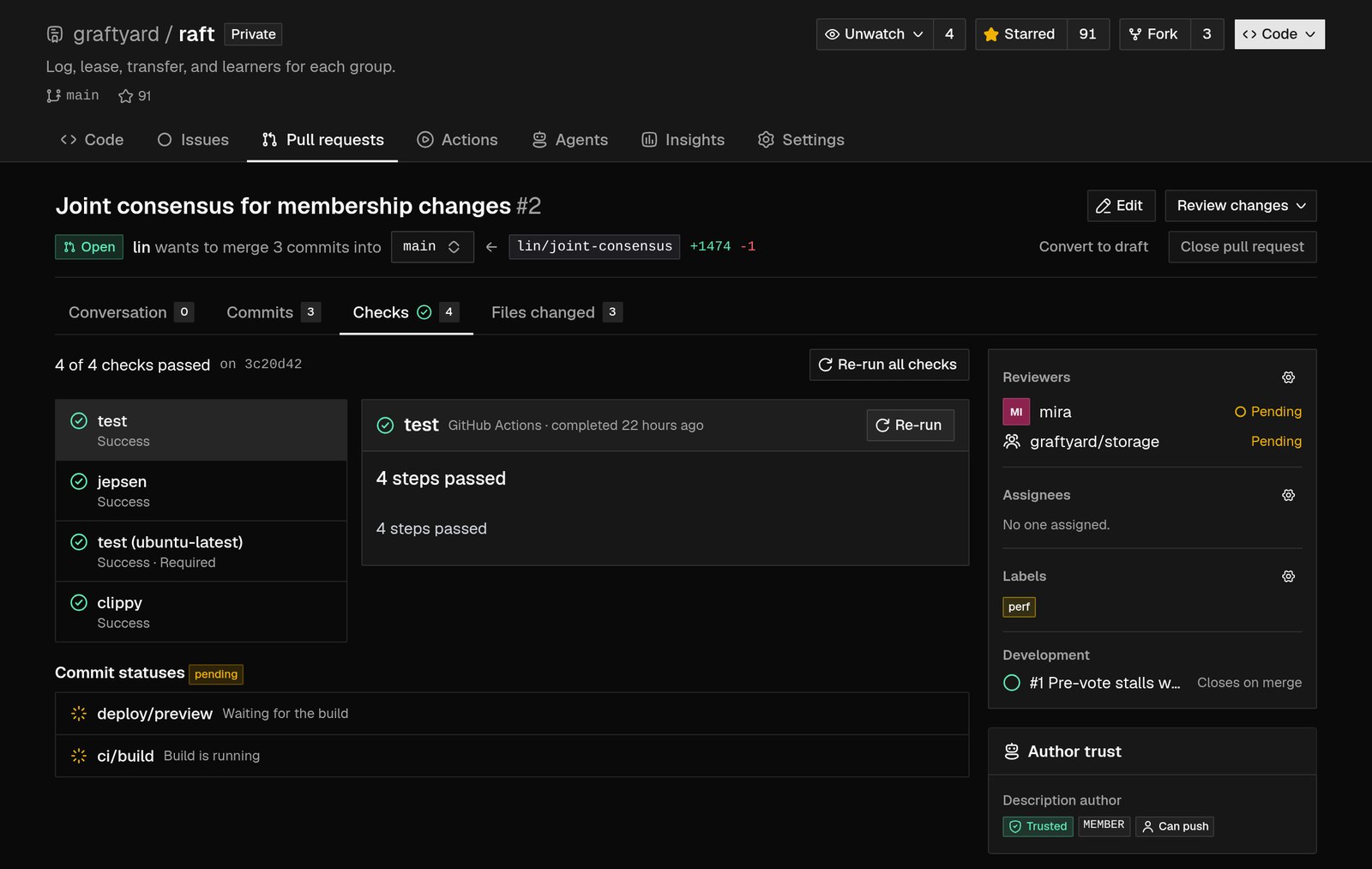
Repositories, pull requests, diffs, checks and reviews, in a layout GitHub users read without a tour. It reads the same GHES 3.22 REST and GraphQL as every other client, plus a small private API for files and diffs.
- 0 API calls before first paint: each page arrives with its first data already in the HTML.
- One failing panel stays one failing panel. With the checks query forced to fail, only the checks region showed an error.
- Passed under Playwright on a hosted test install: sign-in, repository, pull request timeline, diff and checks.
Status
Where the build stands
The code host for people is done: Milestones 0 to 3 are closed, and git, gh, Terraform and Octokit work against it unchanged. Three milestones are under way now.
4 closed3 under way5 to comeIn build order, as of 15 November 2026
Which GitHub version does it match?
GitHub Enterprise Server 3.22. Clients read it from /api/v3/meta and use the GHES paths.
Do I need a new GitHub client or plugin?
No. Point gh, git, your IDE or Terraform at the host as you would at GHES.
Where does Graftyard run?
Only on Cloudflare: as a managed service, in your own Cloudflare account, or self-hosted.
Why not build it on Cloudflare Artifacts?
A new Artifacts repository is capped at 1 GB and lives in one place. The full answer has its own page.
Can AI coding agents use Graftyard?
Yes, as GitHub Apps with ordinary tokens. An opt-in agent layer adds task leases and an activity feed.
When can I use Graftyard?
It is in build. Milestones 0 to 3 are closed, through identity and authorization. Agent scale, Milestone 4 (webhooks, search, Actions and the web app) and Milestone 5 (release control) are under way. The Status page lists every milestone.